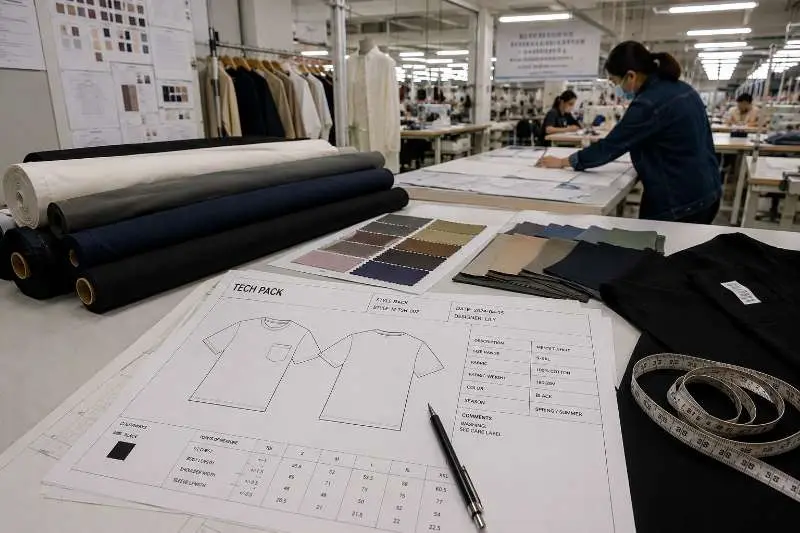
Master private label apparel manufacturing. A comprehensive B2B guide covering OEM vs. ODM production, tech pack development, MOQ negotiation, and quality control.
Transitioning from off-the-shelf wholesale blanks to custom private label manufacturing is the most critical milestone for any growing clothing brand. Custom manufacturing grants complete creative control over garment fits, fabric quality, custom dyeing, and brand hardware. However, navigating the production process requires a clear understanding of factory workflows, technical specifications, and quality control standards. This guide breaks down how to successfully manufacture a private label apparel line from concept to bulk delivery.
1. Understanding Production Models: OEM vs. ODM
Selecting the right manufacturing partner depends on your brand's internal design capabilities:
- OEM (Original Equipment Manufacturer): Full cut-and-sew production where the factory builds garments strictly according to your custom tech packs, patterns, and fabric specifications. Ideal for established brands with unique silhouettes.
- ODM (Original Design Manufacturer): The factory provides pre-developed white-label garment styles that you can customize with your brand’s colors, prints, logos, and custom woven tags. Ideal for launching new collections quickly with lower upfront development costs.
2. The Blueprint of Production: Building an Effective Tech Pack
A tech pack serves as the legally binding master blueprint for your apparel factory. An industry-standard tech pack must include:
- Flat Technical Illustrations: 2D vector drawings showing front, back, and side profiles with detail callouts.
- Measurement Spec Sheet: Precise dimensions for chest, length, shoulders, sleeve length, and leg openings across all graded sizes (S–XXL).
- Bill of Materials (BOM): Complete itemization of raw materials, including fabric weight (GSM), fiber composition, zipper specs, thread colors, and button types.
- Artwork & Branding Placement: Pantone color codes (PMS), exact graphic print dimensions in centimeters/inches, and distance metrics from seams.
3. Understanding MOQs & Optimizing Unit Production Costs
Minimum Order Quantities (MOQs) are dictated by fabric mill dyeing minimums and machine setup times. You can maximize your order efficiency by:
- Sharing Core Fabrics Across Styles: Using the same 400 GSM French Terry fabric for both zip hoodies and sweatpants allows you to hit raw material dye minimums faster.
- Colorway Splitting: Negotiating with your manufacturer to split a total order quantity (e.g., 300 pieces) across 2–3 custom fabric wash colors.
4. The Pre-Production Sampling Protocol
Never proceed directly to bulk manufacturing without completing a strict two-stage sampling process:
- Fit / Proto Sample: Tests garment proportions, sizing drape, and structural seams using available factory fabrics.
- Pre-Production (PP) Sample: The final 100% correct prototype built with your exact custom-dyed fabric, screen prints, custom buttons, woven labels, and poly-bag packaging. Bulk production begins only after written approval of the PP sample.
5. Quality Control (QC) & Retail-Ready Packaging
To prevent costly returns and preserve your brand's reputation, ensure your factory enforces strict quality assurance routines prior to shipment:
- Inline & Final AQL Inspections: Checking seam tolerance, stitch density, zipper smoothness, and measurement accuracy against the tech pack.
- Retail-Ready Finishing: Thread trimming, garment steaming, custom hangtag attachment, tagless neck printing, and individual poly-bagging with scannable SKU barcode labels.